

Because the midterm election primaries inch nearer, some candidates are focusing their campaigns on how they’ll regulate synthetic intelligence. On the suitable, populist Republicans are warning that the AI trade stands to undermine the Make America Nice Once more motion. On the left, there’s fear concerning the sector’s rising political and social energy. Throughout the spectrum, there’s near-universal concern about what the expertise is perhaps doing to youngsters.
The donor class is now getting concerned: A brilliant PAC referred to as Main the Future backed by OpenAI government Greg Brockman and Andreessen Horowitz plans to spend as a lot as $100 million within the midterms to help its most popular candidates. One other bipartisan tremendous PAC, targeted on pushing for a nationwide framework on regulating AI, shaped earlier this week. These fights come because the Trump administration pushes to restrict the power of states to manage the expertise.
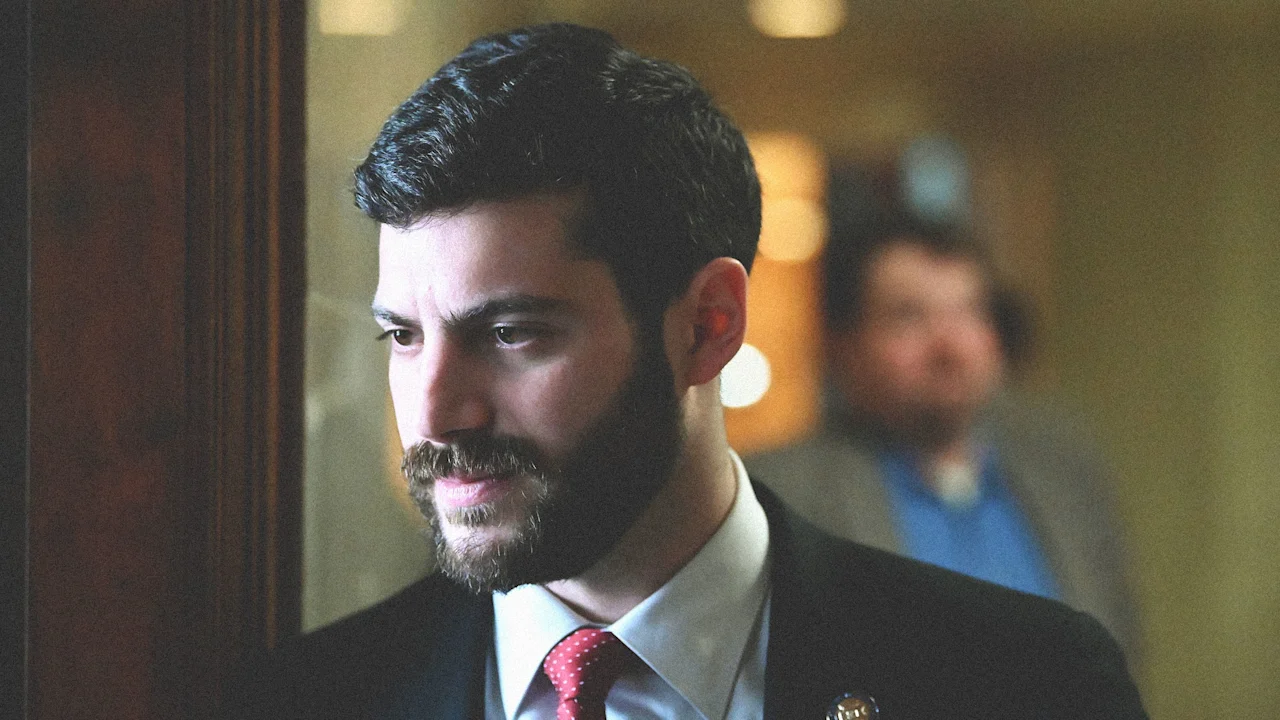
Alex Bores, who authored laws on AI in New York state and is operating to symbolize its twelfth district, has turn into an early goal for Main the Future’s political spending throughout the midterms. “It’s a badge of honor,” he says, evaluating the trouble to an F score from the Nationwide Rifle Affiliation.
“This isn’t tech versus everybody else,” he tells Quick Firm. “That is one small subset of the tech ecosystem that, as a substitute of participating in collaborative discussions on payments and the way we will work for all, has determined they need to drown out the voices of anybody who isn’t them by spending a whole bunch of thousands and thousands.”
Quick Firm chatted with Bores about AI in politics, his time working at Palantir, and what it would take to modernize the federal government. This interview has been edited for size and readability.
One of many issues the draft government order talks about is making a federal strategy to regulating AI by the Trump administration. How significantly do you are taking that?
It’s a cliché in D.C. that whenever you need one thing to not get executed, make a fee to review it. And so making a proposal to review a factor—to perhaps put a coverage ahead—is foolish. I need to be clear, the right reply to those questions is a federal normal. The one motive the states have been performing is as a result of the federal authorities hasn’t. In the event that they need to really work on a federal normal, they are going to discover companions throughout the aisle. What they’re prioritizing is stopping any state from taking motion, not really fixing issues.
We’re in a second when there’s a number of criticism and debate about what the way forward for the Democratic Get together ought to appear to be. In New York, a liberal stronghold, I’m inquisitive about the place conversations about how we should always deal with rising applied sciences and AI would possibly sit within the remaking of the Democratic Get together—and the push to give attention to points that talk to youthful voters and disaffected voters who haven’t been so into what the Democrats have been providing.
We must always all the time be human first and human targeted. The particular ways in which performs out in AI coverage are ones that talk to youthful folks. The most important influence of AI on the job market proper now’s on entry-level jobs, and also you’re seeing an increase in unemployment of individuals in that cohort in search of their first job.
One of the well-liked issues we did in New York this 12 months was phone-free faculties and making it in order that we may really change how tech is used within the classroom and ensure that it’s been used for training and never for screening or scrolling on social media. [Earlier this year, the state instituted new rules on electronic devices during school hours.]
We shouldn’t shoot for one large grand discount on AI, as if it’s a static problem. It’s one thing that infuses all the pieces we do, and we have to regularly be updating our protections because the expertise grows.
Are you able to speak a bit of bit extra about what you probably did at Palantir and your determination to go away?
I used to be at Palantir for 4 and a half years. I spent the overwhelming majority of that point on the federal civilian workforce, and so it was working with the federal government to raised serve the American folks. I labored with the Division of Justice to go after the opioid epidemic. . . . I labored with the Division of Veterans Affairs on higher staffing their hospitals and higher serving veterans. I labored with the CDC [Centers for Disease Control and Prevention] on understanding epidemics.
I’m actually pleased with the work that I did there, as a result of it was all about really making authorities work higher. Separate from tech, I believe that’s the factor that the Democratic celebration and the nation as an entire must see extra of, is people who find themselves prepared to push by the obstacles and ensure that authorities is definitely a pressure for good and serving folks, and never simply the political mudslinging that’s most of what they see on TV.
I left in 2019 when Palantir renewed—or quickly after—Palantir renewed their contract with ICE. Palantir had a contract with Homeland Safety Investigations to assist with combating cross-border drug trafficking and human trafficking. In the course of the first Trump administration, they began utilizing that software program for Enforcement and Removing Operations—for what most individuals consider as deportation. That’s a distinct division inside ICE. . . . That wasn’t one thing that was foreseen when the contract was signed within the Obama administration. And when Palantir renewed that contract, with out slicing off that work or placing in protections that might step up sooner or later, that motivated me to go away.
What do you make of the dialog surrounding Palantir proper now? The corporate has insisted that it’s labored by a number of administrations, however the work with ICE, in addition to with Israel, has sparked main criticisms of the corporate.
I haven’t been there for six years, so I don’t have extra element on how they at the moment function than anybody studying the information, however I’m pleased with the work that I did there and really public with the the explanation why I left.
How onerous is it to purchase expertise in authorities to make issues sooner, extra environment friendly? Authorities modernization—updating authorities software program and offering higher customer support—continues to be a giant problem.
Nobody asks about authorities acquisition. That is superb. It’s horribly inefficient, and that hurts the American folks. It takes the federal government far too lengthy to have the ability to signal a contract, so the associated fee—due to this fact what the American folks find yourself paying—rises.
It then advantages type of the insiders who know find out how to do contracting greater than the individuals who can ship helpful providers, so then the American folks don’t get the advantages from startups and others that may have cheaper, sooner methods of fixing issues.
It’s a drawback at each degree of presidency. One of many first payments I handed in New York, as an Meeting member, was making it simpler for the federal government to really use cloud computing as a substitute of shopping for servers and all the time operating on {hardware}, which slowed down getting providers to New Yorkers. . . . A program referred to as FedRAMP was presupposed to make it simpler to get tech to the federal government: You’d do one safety screening, be licensed, after which be capable of promote to every [federal] division, so that they didn’t must do their very own [screening]. Nevertheless it has turn into an extremely onerous course of that simply makes it far more troublesome to really work with the federal authorities.
Ought to politicians be utilizing generative AI in ads?
I haven’t executed it. However I’ve written the legal guidelines in New York that regulate it, and what we got here to was it needs to be disclosed. And for those who use it to make deepfakes of a candidate, the candidate has the suitable to sue for injunctive reduction with expedited overview to tug that advert down if it’s going to deceive the general public into one thing that truly occurred.
The issue of deepfakes is one which has a technical resolution, and policymakers simply haven’t saved up. Traditionally, we’re instructed it’s . . . simply going to be a cat and mouse sport the place you have got higher detectors of deepfakes after which higher AI turbines [or that] we’ll by no means win that battle. However the trade has created a free, open-source metadata requirements of information referred to as C2PA that may be connected to any normal audio, video, or picture file sort that cryptographically proves whether or not that piece of content material was taken from an precise system, was generated by AI, and/or the way it’s been edited all through the method.
For those who acquired to a spot the place 90%, 95% of individuals have been utilizing that normal, we’ve solved the issue of deepfakes, as a result of anytime you don’t see that credential, you’ll instantly be suspicious of what’s being proven.
